Refrigerant Leak Repair in Wilmington: Signs, Costs, and Options
Refrigerant is the chemical compound that makes air conditioning possible. It cycles between your indoor evaporator coil and outdoor condenser, absorbing heat inside your home and releasing it outside. Without the correct amount of refrigerant — called the "charge" — your system cannot cool effectively. And in Wilmington, NC, where we rely on air conditioning six to seven months per year, a refrigerant leak is not something you can ignore.
How Refrigerant Leaks Happen
Air conditioning systems are designed as sealed, closed-loop systems. Refrigerant circulates through copper and aluminum tubing, brazed joints, and valve connections. Under ideal conditions, refrigerant should never need to be "topped off" — if the charge is low, it means refrigerant is escaping somewhere.
Common causes of leaks in Wilmington:
- Corrosion from salt air. This is the biggest factor in our coastal region. Salt-laden air from the Atlantic and the Cape Fear River corrodes copper refrigerant lines and aluminum condenser coils over time, creating pinhole leaks. Homes in Wrightsville Beach, Carolina Beach, and Kure Beach are especially vulnerable.
- Vibration wear. Years of compressor operation creates microscopic vibration that fatigues tubing at joints and connection points.
- Formicary corrosion. A specific type of corrosion caused by volatile organic compounds (VOCs) from household cleaners, paints, and adhesives reacting with copper tubing. It creates tiny, ant-nest-like tunnels in the copper that eventually become leaks.
- Manufacturing defects. Some systems develop leaks at factory-brazed joints within the first few years. These are typically covered under manufacturer warranty.
- Physical damage. Weed trimmers hitting outdoor line sets, animals chewing on insulation, or contractor damage during other home projects.
Signs You Have a Refrigerant Leak
Refrigerant leaks can be slow (losing charge over weeks or months) or sudden (a significant rupture). Here is what to watch for:
Performance signs:
- AC runs but blows warm or lukewarm air
- The house takes much longer to reach the set temperature than it used to
- Ice formation on the evaporator coil or refrigerant lines (see our guide on frozen evaporator coils)
- The system runs almost continuously during hot days without satisfying the thermostat
Sensory signs:
- Hissing or bubbling sounds near the indoor or outdoor unit — hissing indicates a gas-phase leak, bubbling indicates a liquid-phase leak
- A sweet, chloroform-like smell near the outdoor unit (some refrigerants have a faintly sweet odor)
Cost signs:
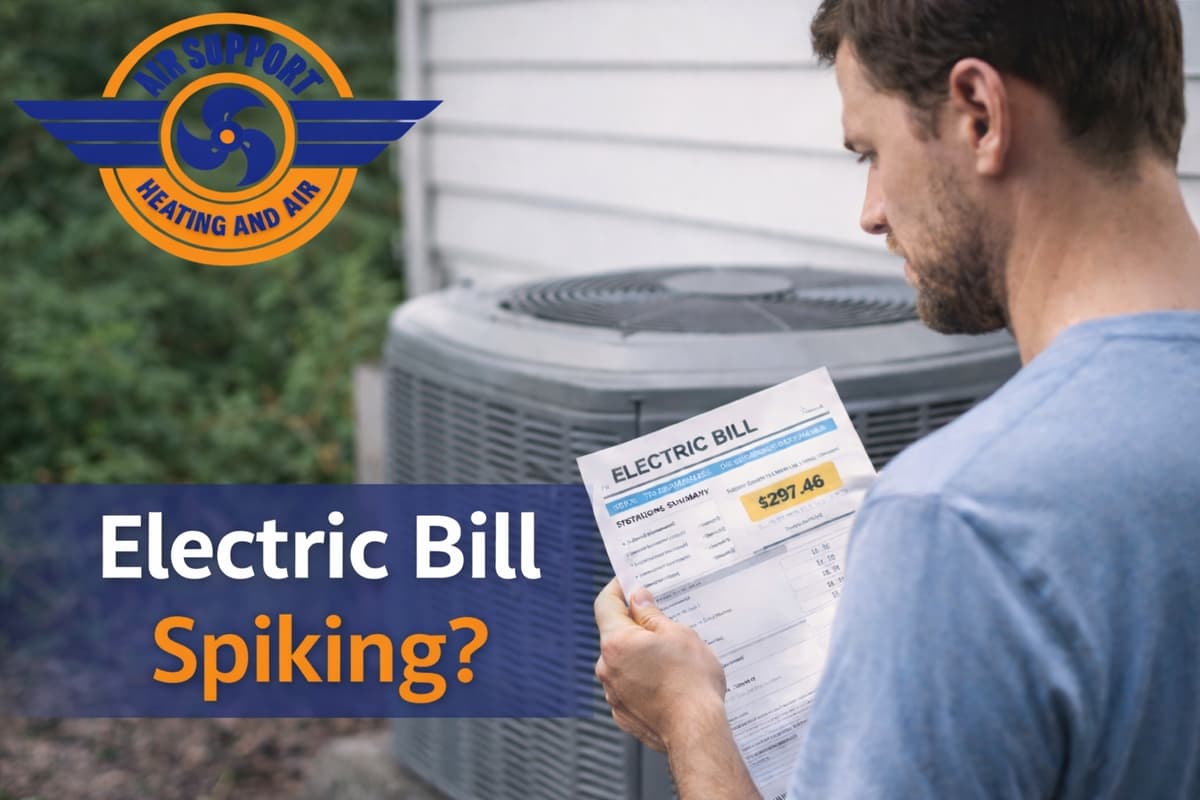
- Electric bills climbing with no other explanation — a low-charge system runs longer and harder, consuming significantly more electricity
- Frequent service calls for the same issue — if a technician has added refrigerant in the past and you are having the same symptoms again, the original leak was never repaired
Health and Safety Risks
Refrigerant is generally not dangerous in the small quantities that leak from a residential system in a well-ventilated area. However, there are real risks to be aware of:
- In confined spaces, a significant refrigerant leak can displace oxygen, creating a suffocation hazard. This is most relevant for systems in small mechanical closets or sealed utility rooms.
- Direct skin contact with liquid refrigerant causes frostbite-like cold burns.
- Inhaling refrigerant intentionally (sometimes called "huffing") is extremely dangerous and can cause sudden cardiac arrest.
- Environmental impact: Refrigerants are potent greenhouse gases. R-410A, the most common residential refrigerant currently in use, has a global warming potential (GWP) 2,088 times that of CO2. The EPA takes refrigerant handling seriously for this reason.
Why DIY Refrigerant Work Is Illegal
Under Section 608 of the Clean Air Act, it is illegal to knowingly vent refrigerant into the atmosphere. The EPA requires that anyone purchasing or handling refrigerant be Section 608 certified. This is not a suggestion or a best practice — it is federal law, enforced with fines up to $44,539 per day per violation as of 2024.
This means:
- You cannot legally buy refrigerant without EPA certification
- You cannot legally add refrigerant to your own system
- You cannot legally repair refrigerant lines without proper recovery equipment
- Any refrigerant removed during service must be recovered, not vented
Online marketplaces occasionally sell refrigerant to uncertified buyers, but purchasing and using it without certification is a violation regardless of where you bought it. Always hire a licensed, EPA-certified HVAC technician for any refrigerant-related work. All Air Support technicians carry Section 608 Universal certification.
R-22 vs. R-410A: Why It Matters
If your system was installed before 2010, there is a strong chance it uses R-22 (Freon), which was fully phased out of production and import in the United States on January 1, 2020, under the EPA's Montreal Protocol commitments.
What this means for you:
- R-22 is no longer manufactured — all remaining supply is reclaimed or recycled
- The price has skyrocketed: $75 to $150+ per pound in our area, compared to $10 to $25 per pound for R-410A
- A typical residential system holds 6 to 12 pounds of refrigerant
- Recharging an R-22 system after a leak can cost $500 to $1,800 just for the refrigerant, plus leak repair labor
R-410A has been the standard residential refrigerant since 2010. It is more readily available and significantly less expensive. However, the industry is now transitioning to R-454B (Solstice), a lower-GWP refrigerant that will become the standard for new systems manufactured after January 2025 under the EPA's AIM Act.
The bottom line: If you have an R-22 system with a refrigerant leak, the economics almost always favor system replacement over repeated recharging. You are paying premium prices for a scarce refrigerant in an aging system that will only develop more leaks over time.
Repair Process and Costs
When you call Air Support for a suspected refrigerant leak, here is what to expect:
Step 1: Diagnostic ($89-$150)
Our technician will measure the refrigerant charge, check superheat and subcooling values, and confirm that a leak exists.
Step 2: Leak detection ($150-$300)
We use electronic leak detectors, UV dye, and nitrogen pressure testing to pinpoint the leak location. Some leaks are obvious — corroded line sets or visibly damaged coils. Others are microscopic and require systematic testing of every joint and connection.
Step 3: Repair estimate
Based on the leak location and system condition, we provide a written estimate. Common repair scenarios:
- Leaking Schrader valve or service port: $150 to $300 — simple and cost-effective
- Leaking brazed joint on accessible line set: $300 to $600 — requires cutting, re-brazing, pressure testing, and recharging
- Leaking evaporator coil: $800 to $2,500 — often requires coil replacement, which involves significant disassembly of the air handler
- Leaking condenser coil: $1,000 to $3,000 — may require replacement of the entire outdoor unit depending on age and availability of the coil
*These ranges are typical for the Wilmington area. Your actual cost depends on system type, refrigerant type, leak location, and warranty status.*
Step 4: Repair, evacuate, and recharge
After the physical repair, the system is evacuated (all air and moisture removed with a vacuum pump), leak-tested under pressure, and recharged with the exact amount of refrigerant specified by the manufacturer.
Repair vs. Replace: The Decision Framework
Use this framework to make the smartest financial decision:
Lean toward repair if:
- The system is less than 8 years old
- The leak is in an accessible location (line set, service valve)
- Total repair cost is less than 30 to 40 percent of a new system
- The system uses R-410A
- The compressor and other major components are in good condition
Lean toward replacement if:
- The system is more than 12 years old
- The system uses R-22 refrigerant
- The leak is in the evaporator or condenser coil
- You have had multiple leak repairs in the past 2 to 3 years
- The repair cost approaches 50 percent or more of a new system
- The system has other performance or efficiency problems
For borderline cases, our technicians provide an honest assessment and help you weigh the options. We offer financing for both repairs and new system installations to keep the decision about what is best for your home, not just what you can pay for today.
Preventing Refrigerant Leaks
While you cannot prevent every leak, you can reduce the risk:
- Annual maintenance catches early signs of corrosion and wear before they become active leaks
- Protect the outdoor unit from weed trimmers and lawn equipment
- Rinse the outdoor coil with a garden hose every few months to remove salt and debris — especially important for beach properties
- Install a surge protector for the outdoor unit — electrical surges can damage compressor valves, leading to internal leaks
- Consider a coastal-rated condenser coil with enhanced corrosion protection if you live within a few miles of the ocean
Call Air Support at (910) 469-1459 or schedule online.