R-22 Refrigerant Phase-Out: What It Means for Your Old AC System
If your air conditioning system was installed before 2010, there is a good chance it runs on R-22 refrigerant, also known by its brand name Freon. And if you have not heard the news yet, here it is: R-22 has been phased out by the federal government, and the consequences for homeowners with older AC systems are real and growing more expensive every year.
Here in Wilmington, NC, where we rely heavily on air conditioning from April through October, understanding the R-22 phase-out is not optional -- it is essential for protecting your comfort and your wallet.
What Is R-22 and Why Was It Banned?
R-22 is a hydrochlorofluorocarbon (HCFC) that was the standard refrigerant in residential air conditioning systems for decades. It worked well, but scientists discovered that HCFCs deplete the Earth's ozone layer -- the atmospheric shield that protects us from harmful ultraviolet radiation.
In response, the U.S. Environmental Protection Agency (EPA) implemented a phased reduction of R-22 production and imports under the authority of the Clean Air Act and the Montreal Protocol:
- 2010: R-22 could no longer be used in new equipment manufactured in the U.S.
- 2015: Production and import limits were significantly tightened
- January 1, 2020: All production and import of R-22 was permanently banned
This means the only R-22 available today comes from reclaimed or recycled supplies -- and that supply is shrinking every year.
How the Phase-Out Affects Your AC System
If your AC still uses R-22, here is what you need to understand:
Skyrocketing Refrigerant Costs
The law of supply and demand is working against you. With no new R-22 being produced and existing stockpiles dwindling, prices have increased dramatically. What used to cost $50-75 per pound now regularly exceeds $150-250 per pound in many markets. A typical AC system holds 5-15 pounds of refrigerant, so a single recharge after a leak can cost $750 to $3,750 or more -- just for the refrigerant.
According to the Air-Conditioning, Heating, and Refrigeration Institute (AHRI), the price trend for R-22 will only continue upward as supplies become scarcer.
Harder to Find Qualified Service
As R-22 systems become less common, fewer HVAC companies stock reclaimed R-22. Emergency repairs that once took a few hours may now require days while your technician sources refrigerant. In the middle of a Wilmington summer, that wait is not just inconvenient -- it can be dangerous, especially for elderly residents and families with young children.
Your System Is Aging Out
Any AC system still running on R-22 is at least 15 years old, and likely older. The average lifespan of a central air conditioning system is 15-20 years. Even if your system is technically still functioning, it is operating well below its original efficiency, costing you more on every electricity bill, and increasingly likely to suffer a catastrophic compressor or coil failure that is not worth repairing.
What Are the Replacement Refrigerants?
The HVAC industry has transitioned to newer, ozone-friendly refrigerants:
R-410A (Puron)
R-410A has been the industry standard replacement since 2010. It does not deplete the ozone layer and operates at higher pressures than R-22, which means it delivers better heat transfer and improved energy efficiency. Every new residential AC system installed between 2010 and 2024 likely uses R-410A.
However, R-410A has a high global warming potential (GWP), which has led to the development of the next generation of refrigerants.
R-454B (Opteon XL41)
Starting in 2025, the EPA's AIM Act is driving a transition toward lower-GWP refrigerants like R-454B. This next-generation refrigerant has approximately 78% lower GWP than R-410A while delivering comparable cooling performance. Major manufacturers including Carrier, Trane, and Daikin are already producing equipment designed for R-454B.
For homeowners replacing an R-22 system today, the choice between R-410A and R-454B equipment depends on availability, budget, and how forward-looking you want to be.
Can You Just "Convert" Your Old System?
You may have heard about drop-in replacement refrigerants like R-407C or R-422D that claim to work in existing R-22 equipment. Here is the reality:
- No refrigerant is a true drop-in replacement for R-22 in most residential systems
- Retrofit refrigerants often require oil changes, metering device adjustments, and other modifications
- Performance is typically 10-20% lower than the original R-22 specification
- Many equipment manufacturers void the warranty if non-approved refrigerants are used
- The cost of retrofitting an aging system rarely makes financial sense when compared to replacement
The AHRI and most major manufacturers recommend system replacement rather than refrigerant conversion for R-22 systems.
When Should You Replace Your R-22 System?
Here is our straightforward advice based on years of experience serving Wilmington homeowners:
Replace now if:
- Your system needs a refrigerant recharge (you have a leak)
- Your compressor or evaporator coil has failed
- Your energy bills have been climbing steadily
- Your system is 15+ years old and requiring frequent repairs
- You want to take advantage of available federal tax credits and rebates
You can wait (briefly) if:
- Your system is running without any refrigerant leaks
- It is still cooling your home adequately
- You have had it professionally maintained and it is in good condition
But understand that waiting is a gamble. Every summer that passes increases the odds of a failure that leaves you scrambling for emergency AC replacement during our busiest season -- when wait times are longest and scheduling is tightest.
What to Expect When You Upgrade
Replacing an R-22 system with a modern unit is one of the best investments you can make in your home. Here is what the upgrade delivers:
- 30-50% lower energy bills thanks to dramatically improved SEER2 ratings
- Reliable cooling with a full manufacturer warranty
- Environmentally responsible refrigerants that comply with current and upcoming regulations
- Quieter operation -- modern systems are significantly less noisy than units from the early 2000s
- Smart thermostat compatibility for even greater efficiency and convenience
- Potential tax credits of up to $2,000 for qualifying high-efficiency heat pump systems
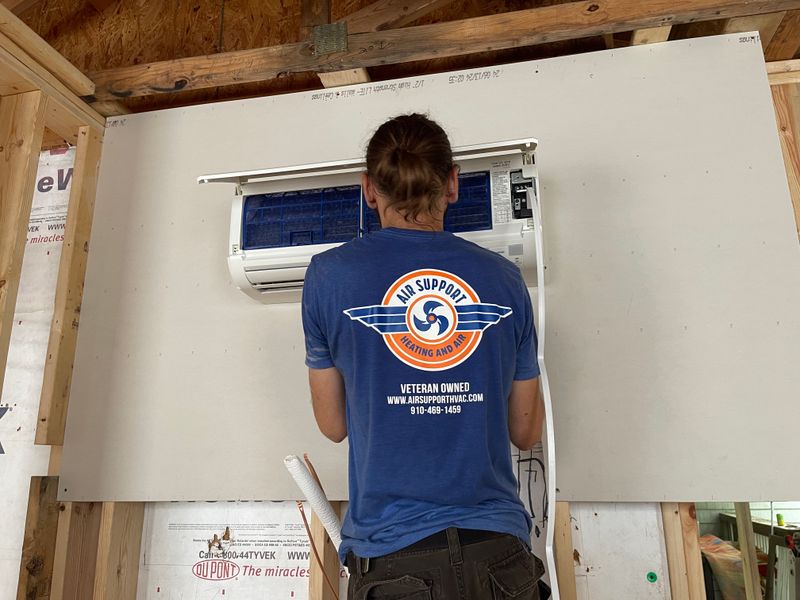
Our team at Air Support Heating and Air handles the entire process, from the initial free estimate to permit filing, professional installation, old system disposal, and final inspection.
Protect Your Home and Your Budget
The R-22 phase-out is not a future problem -- it is a present reality. If your AC system still runs on R-22, the best time to plan your replacement is before the next emergency. Proactive replacement lets you choose the right system for your home on your schedule, rather than making a rushed decision in the middle of a heat wave.
If you are not sure what refrigerant your system uses, check the data plate on the outdoor unit or give us a call. We will tell you exactly where you stand and what your best options are -- with honest, transparent pricing and zero pressure.
Call Air Support Heating and Air at (910) 469-1459 or schedule a free AC replacement estimate online. If your system needs AC repair in the meantime, we offer same-day service to keep you comfortable while you plan your next move.