What to Do When Your AC Breaks Down: Emergency Cooling Tips
There is nothing quite like the sinking feeling of walking into your home on a scorching Wilmington summer day and realizing your air conditioner has stopped working. With temperatures regularly climbing into the mid-90s and humidity levels that make it feel even hotter, an AC breakdown is not just an inconvenience -- it can be a genuine health emergency, especially for young children, elderly family members, and pets.
Before you panic, take a deep breath. Here is a step-by-step guide to staying safe, keeping your home as cool as possible, and knowing when it is time to call in the professionals for emergency HVAC service.
Step 1: Rule Out Simple Fixes First
Before assuming the worst, check these common culprits that can mimic a full system failure:
- Thermostat settings -- Make sure it is set to "cool" and the fan is set to "auto" or "on." Sometimes a family member or a bump accidentally changes the settings.
- Circuit breaker -- Check your electrical panel. If the HVAC breaker has tripped, reset it once. If it trips again, do not keep resetting it -- this indicates an electrical problem that needs professional attention.
- Air filter -- A severely clogged filter can cause the system to overheat and shut down. If your filter is visibly dirty, replace it and give the system 30 minutes before restarting.
- Outdoor unit -- Go outside and check the condenser unit. Is it running? Is it blocked by debris, overgrown vegetation, or covered up? Clear at least 2 feet of space around it.
If none of these quick checks resolve the issue, you are likely dealing with a mechanical or refrigerant problem that requires professional AC repair.
Step 2: Understand the Health Risks
The Centers for Disease Control and Prevention (CDC) warns that extreme heat causes more deaths in the United States than any other weather-related event. Heat-related illness can escalate quickly, and certain groups are at higher risk:
- Infants and young children whose bodies regulate temperature less efficiently
- Adults over 65 who may have chronic medical conditions or take medications that affect heat response
- People with heart disease, diabetes, or respiratory conditions
- Pets, especially dogs and cats left indoors without cooling
Warning signs of heat exhaustion include heavy sweating, weakness, cold or clammy skin, nausea, and a fast but weak pulse. Heat stroke -- a medical emergency -- presents with high body temperature (above 103 degrees F), hot and dry skin, confusion, and loss of consciousness.
If anyone in your household shows signs of heat stroke, call 911 immediately and move them to the coolest area available.
Step 3: Emergency Cooling Strategies
While you wait for repairs, use these proven strategies to keep your home as cool as possible:
Close Blinds and Curtains
Solar heat gain through windows is one of the biggest drivers of indoor temperature. Closing blinds, curtains, and shades -- especially on south- and west-facing windows -- can reduce indoor temperatures by up to 20 degrees, according to the U.S. Department of Energy.
Use Fans Strategically
Fans do not actually cool the air, but they create a wind-chill effect that makes you feel cooler. For maximum effectiveness:
- Position a box fan in a window facing outward on the shady side of your home to push hot air out
- Place a bowl of ice in front of a fan to create a makeshift evaporative cooler
- Use ceiling fans in a counterclockwise direction to push air downward
Minimize Heat Sources
Every appliance generates heat. During an AC outage:
- Avoid using the oven or stove -- eat cold meals, use a microwave, or grill outdoors
- Turn off unnecessary lights, especially incandescent bulbs which convert 90% of their energy to heat
- Unplug electronics that generate heat even in standby mode
- Postpone laundry and dishwasher use, which add heat and humidity
Stay Hydrated
The American Red Cross recommends drinking plenty of water even before you feel thirsty. Avoid alcohol, caffeine, and sugary drinks, which can contribute to dehydration. Keep a water bottle with you at all times.
Seek Cool Zones
If your home becomes dangerously hot:
- Move to the lowest level of your home, since heat rises
- Use a basement or interior room away from direct sunlight
- Wet towels or bandanas and place them on your neck and wrists for rapid cooling
- Take cool (not cold) showers to lower your body temperature
- If indoor temperatures become unsafe, go to a public cooling center, library, shopping mall, or a friend's home with working AC
Step 4: Know When to Call a Professional
Some AC problems are minor and can wait until the next business day. Others demand immediate emergency service. Call for emergency repair if:
- Your home temperature exceeds 85 degrees F and you have vulnerable household members
- You hear unusual sounds like grinding, screeching, or banging from the unit
- You smell burning or detect an electrical odor
- You see ice forming on the indoor or outdoor unit
- Refrigerant is leaking -- visible oily residue near the unit or a sweet chemical smell
- The system repeatedly trips the breaker after resetting
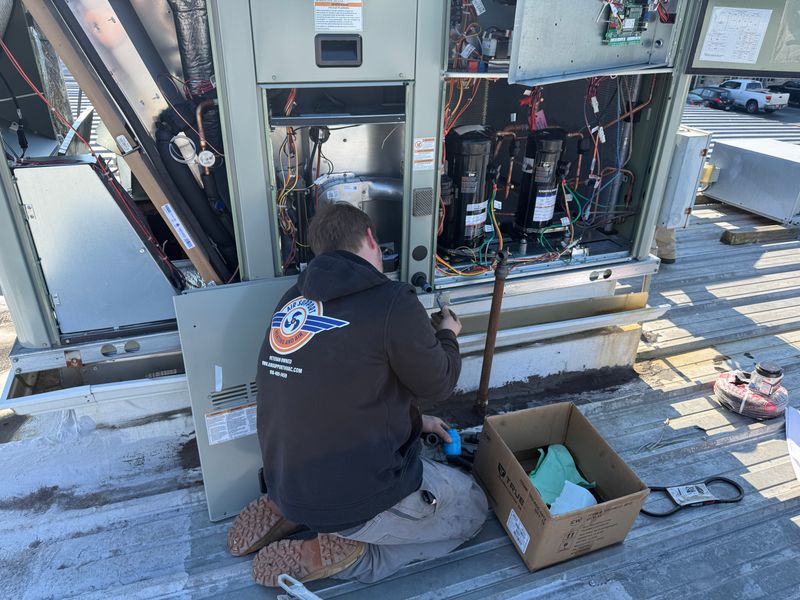
At Air Support Heating and Air, we offer 24/7 emergency HVAC service for exactly these situations. Our technicians respond quickly because we understand that in Wilmington's summer heat, time matters.
Step 5: Prevent Future Breakdowns
The best emergency is the one that never happens. Here is how to reduce your risk of an unexpected AC failure:
- Schedule regular maintenance -- Professional tune-ups catch small problems before they become big failures. Ideally, have your system serviced every spring before the cooling season begins.
- Change your air filter every 1-3 months -- A clean filter improves airflow, reduces strain on the system, and prevents overheating.
- Keep the outdoor unit clear -- Trim vegetation, remove debris, and ensure proper airflow around the condenser.
- Address repairs promptly -- Strange noises, weak airflow, or warm air from the vents are warning signs. Do not wait for a complete breakdown to call for service.
- Consider a maintenance plan -- Our Guardian maintenance plan includes two annual tune-ups, one free service call per year, and priority scheduling to keep your system running reliably.
Call Air Support Heating and Air
When your AC fails in the Wilmington heat, Air Support Heating and Air has your back with fast, reliable emergency HVAC service and expert AC repair. We are available 24/7 because your comfort and safety cannot wait.
Call (910) 469-1459 now or book online. Your comfort is our mission -- and we will prove it.